
Standard RAG: The Foundation You Should Not Skip
March 2, 2025
Before you reach for exotic RAG variants, master the foundation. Standard RAG is the simplest pipeline and the benchmark every more advanced pattern is measured against.
What It Is
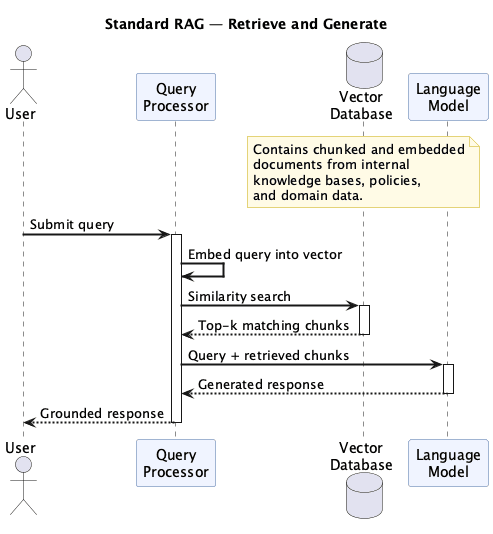
Standard RAG connects a vector database to a language model in three steps: embed the query, retrieve semantically similar documents, generate the answer from them. The document corpus is chunked ahead of time, turned into vectors, and stored in a database such as Qdrant, Pinecone, or Weaviate. There is no hidden magic — and that is exactly why it is the right starting point.
How It Works
The pipeline follows four straightforward steps. First, your documents are split into smaller, manageable segments — a process known as chunking. Second, each segment is converted into a numerical representation (an embedding) and stored in a vector database. Third, when a user submits a query, that query is also embedded and matched against the stored segments using similarity scoring. Finally, the most relevant segments are passed to the language model, which generates a response grounded in that context.
Where It Delivers Value
This architecture works well in scenarios where the knowledge base is well-curated and queries are straightforward. Internal knowledge bases, FAQ systems, or employee handbooks are classic use cases. A startup deploying a help-desk bot that answers policy questions from an HR manual is a textbook example.
Strengths
Response times are fast — often sub-second. Operational costs remain low because the pipeline is lean. Debugging and monitoring are straightforward since the data flow is linear and predictable.
Limitations
Standard RAG assumes your retrieval engine returns the right documents every time, which is rarely the case at scale. It struggles with irrelevant results creeping in, cannot decompose multi-part questions, and has no built-in mechanism to verify whether the retrieved data actually supports the generated answer.
The Bottom Line
Start here. If Standard RAG does not perform well for your use case, adding architectural complexity on top will not save you. Master chunking strategies, embedding quality, and evaluation metrics before moving on to more advanced patterns.
Sources
Lewis et al. — Retrieval-Augmented Generation for Knowledge-Intensive NLP Tasks (2020)