
Corrective RAG (CRAG): Built-In Quality Control
March 4, 2025
Standard RAG blindly trusts whatever the vector search returns — and hallucinates the moment the matches are weak. Corrective RAG slots a quality check in between, before anything reaches the language model.
What It Is
Right after retrieval, an evaluator — typically a dedicated LLM or a lightweight classifier — scores whether the retrieved chunks actually answer the question. Based on that score the system either passes the results through, refines the search, or falls back to a web query. Bad retrieval never makes it to the generator.
How It Works
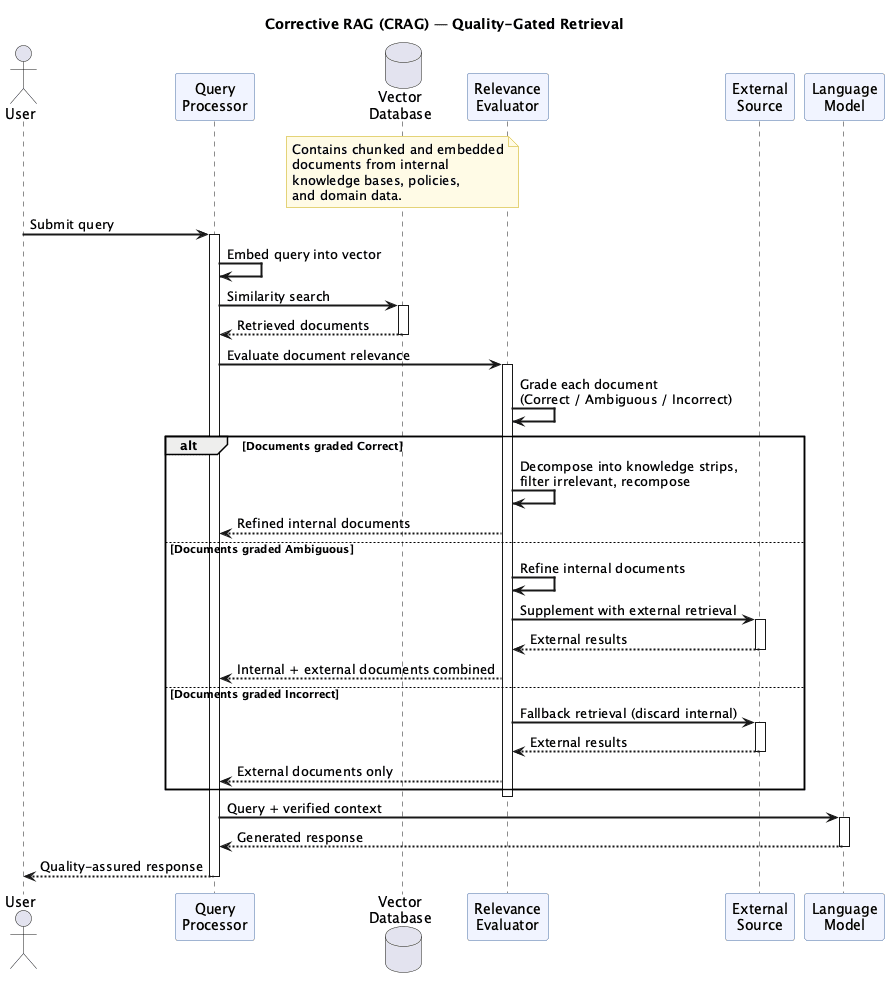
The pipeline starts like any standard retrieval — documents are fetched from the internal vector database. Before those documents move forward, a lightweight evaluator grades each one as Correct, Ambiguous, or Incorrect. Each grade triggers a distinct path. Correct documents pass through a knowledge refinement step — a decompose-then-recompose process that breaks documents into fine-grained knowledge strips, filters out irrelevant content, and reassembles the useful parts. Ambiguous documents trigger both internal refinement and a parallel external search, combining the best of both sources. Incorrect documents are discarded entirely and replaced by results from an external source — such as a web search API or a specialised data provider.
Where It Delivers Value
This architecture shines in high-stakes environments where accuracy is non-negotiable. Financial advisory systems, healthcare platforms, and legal research tools all benefit from having a built-in verification layer. When a financial bot is asked about a stock price that is not in its database, CRAG recognises the gap and pulls live data from an external API rather than guessing.
Strengths
Hallucination rates drop significantly because the system no longer generates answers from weak or irrelevant context. The ability to bridge internal and external data sources makes responses more comprehensive and current.
Limitations
The evaluation and fallback steps add noticeable latency — potentially adding several seconds per query. External API dependencies also introduce cost considerations and rate-limiting constraints that need careful management.
The Bottom Line
When the cost of a wrong answer is high — regulatory fines, medical risk, legal liability — Corrective RAG is worth the additional latency and expense. For low-stakes applications, the overhead may not be justified.
Sources
Yan et al. — Corrective Retrieval Augmented Generation (2024)