
Adaptive RAG: Matching Effort to Complexity
March 5, 2025
Not every question deserves the same effort. Adaptive RAG sorts queries by difficulty and sends each one down the cheapest path — from a direct LLM reply to multi-step research.
What It Is
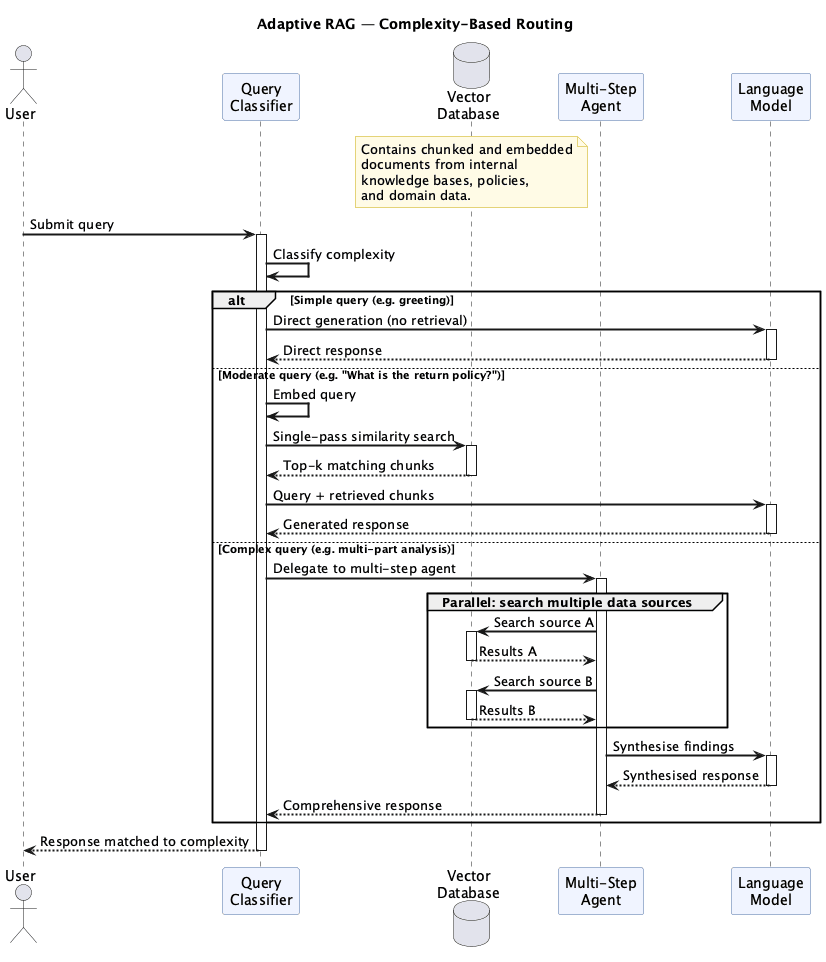
A router classifies every incoming query by complexity. A greeting goes straight to the LLM, a factual question runs through standard retrieval, a multi-faceted analytical query triggers multi-step retrieval or a web search. The system avoids wasted effort on simple cases without sacrificing answer quality on the hard ones.
How It Works
At the front of the pipeline sits a small classifier model that analyses each query and assigns it a complexity level. Simple queries — greetings, general knowledge, small talk — are answered directly by the language model without any retrieval at all. Moderate queries trigger a single-pass retrieval, identical to Standard RAG. Complex queries activate a multi-step agent workflow that searches across multiple data sources and synthesises the findings.
Where It Delivers Value
Consider a university assistant system. When a student says "Hello," the system responds instantly with no database call. When they ask "What are the library hours?", a quick vector search provides the answer. When they ask "Compare tuition trends across three programmes over the last five years," the system launches a deeper analytical process. Each interaction uses only the resources it needs.
Strengths
Cost savings are substantial because the majority of real-world queries tend to be straightforward. Latency stays optimal for simple requests since they bypass the retrieval pipeline entirely. The system scales more gracefully because expensive operations are reserved for genuinely demanding questions.
Limitations
The routing model is a single point of failure. If it misclassifies a difficult question as simple, the system will produce a shallow or incorrect response without ever consulting the knowledge base. Building and maintaining a reliable classifier requires ongoing tuning.
The Bottom Line
Adaptive RAG is the right choice when your query traffic varies widely in complexity and you want to keep infrastructure costs under control without sacrificing quality on the hard questions.