
Self-RAG: The Architecture That Questions Its Own Answers
March 6, 2025
External evaluators only catch errors after the answer is already written. Self-RAG moves the critique into the model itself — through reflection tokens that let the LLM assess its own output while generating it.
What It Is
During training, the model learns four control tokens: Retrieve (do I even need to look something up?), ISREL (are the hits relevant?), ISSUP (do the sources back up my claim?), ISUSE (is the answer useful?). They work like an inner monologue that audits every stage of the response before it reaches the user.
How It Works
Unlike other RAG patterns, the process does not begin with automatic retrieval. The model first generates a Retrieve token that decides whether external documents are needed at all — some queries can be answered from the model's own knowledge. If retrieval is triggered, the model evaluates each returned document using four specialised reflection token types: IsRel (is the context relevant?), IsSup (does the source support the claim?), IsUse (is the response useful, scored 1–5?), and Retrieve (should the system retrieve again?). Generation proceeds segment by segment. When a statement lacks support, the model triggers re-retrieval and revision before continuing to the next segment.
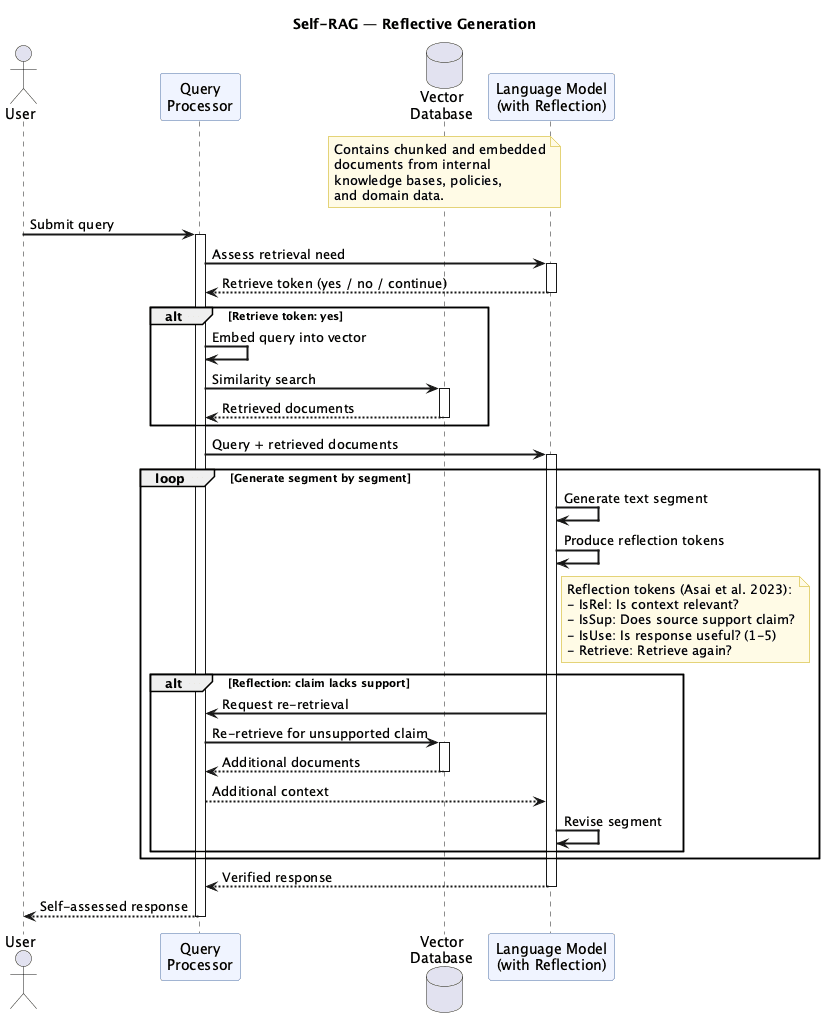
Where It Delivers Value
Legal research is a compelling example. Imagine a system drafting a case summary that references a specific precedent. Mid-generation, the reflection mechanism flags that the cited document does not actually support the claim being made. The system automatically searches for a more appropriate reference and corrects the output — all before the user sees anything.
Strengths
This approach achieves one of the highest levels of factual reliability among RAG architectures. The built-in transparency of the reflection process also creates an auditable trail that is valuable in regulated industries.
Limitations
Self-RAG demands specialised, fine-tuned models — off-the-shelf language models cannot produce reflection tokens natively. The computational overhead is also significant, as the model is effectively doing double duty: generating content and critiquing it simultaneously.
The Bottom Line
When your application demands the highest level of output integrity and you have the engineering resources to support fine-tuned models, Self-RAG delivers unmatched accuracy. For teams with limited budgets, the investment may be premature.
Sources
Asai et al. — Self-RAG: Learning to Retrieve, Generate, and Critique through Self-Reflection (2023)